
The award for the best editing goes to

No.

I am not a religious Zealot. I love the Chinese. Especially their movies and food. I am an animals and reptiles person. I don’t mean them harm.

This is not an announcement for an award for editing. It ought to be. Fortunately or unfortunately, it isn’t.

Recently, an esteemed blogger and good friend of mine, while reviewing my book, commended my publisher for almost perfect, error free, book.

I glowed in pride. I am so happy. I am going to tell you why.

Writing a book is not about writing a book. You would think that. You would say, what’s this guy talking about? Of course writing a book is about writing a book, what else could it be, making a snake walk? Or maybe he thinks its about body building. This guy’s a moron. Well, think what you might, I stick to my stance. Writing a book is not about writing a book.

It is about presenting a work of fiction. It has many layers to it. First the skeleton, just the basic structure, the bones of the matter. You can call it the basic premise. It should not take long, right?

Wrong!

It takes forever. You create your main character. You build a world around him or her. You figure out his strength, his weakness, his fatal flaws, his love and what he hates. You have to think of what his challenge is and who or what will pose that challenge. Once you get that right, you have your villain, support characters (some stay, some succumb to chop-chop) and then the circumstances that lead to the story.

This is not done in a day by staring steadfastly at your laptop. This is acquired through reflection of all those things that happened in your life or that of people around you. For instance, the concept that by its very nature the Universe gravitates towards chaos, the basis of my Kronikles Series, came to me because of noticing mundane things like fading flowers and leaky rubber hose pipes in my car that wither with the passage of time.

Once you get your skeleton right, you need to buff it up with flesh and blood. There comes your story structuring. At first everything was fine on Earth and God was in Heaven. Then Lucifer brings the forbidden fruit of desire to the garden of Eden in the form of a snake where Adam and Eve, (both non-Chinese), spare the snake and eat the apple. You see, there lies your story. They were not Chinese. If they were, everything would have been fine and we would still be gliding formlessly in eternal bliss. It requires one to reflect meditatively on how important it is to be Chinese. Where were they when we needed them. Or maybe you would suggest that they consume snakes to repent the fact that they were missing in action when creation most needed them.

And thus the flesh and blood of your story starts to take shape.

Then you bring in the nervous system. How is your tale going to make the audience react. Will they be repulsed, will they feel for the Chinese hero, will they join in his quest to vandalize as many snakes as possible? It is important to involve your audience emotionally. To ache for the tragic hero or laugh with the comic one or be courageous with the mighty warrior who can do impossible feats in the air, ground and water to annihilate all vipers off the face of Earth.

So there you have it. You’ve not written a book, have you? You’ve lived through an adventure. You think your job’s done, right?

Wrong again!

Now comes the most important part of your book. Giving it the skin, the sheen, the beauty, the presentability. That, my dear people, is the editing part. No matter how well you’ve done your work, you haven’t done it well enough. Take it from me. Whoever tells you they finished the book in one sitting is either lying or they are lying. Either of the two.

According to newer belief systems (mine is about 10,000 years old), God took six days to make creation. God-took-six-days. Period.

Thus, editing is not editing. (Oh shut up. First, writing is not writing, now editing is not editing. What’s it going to be, reading is about feeling my butt?)

By that, I mean, there is no use if an author edits. An author writes. An editor, edits. One rule. No change. (how is that editing is not editing? Just read, will you!)

In my case, there were four main editors and about a million others who gave their opinion on the book. One of the four editors was from my publisher. One. A good one. A guy I like a lot. But a lot of work went into the book before he got to it.

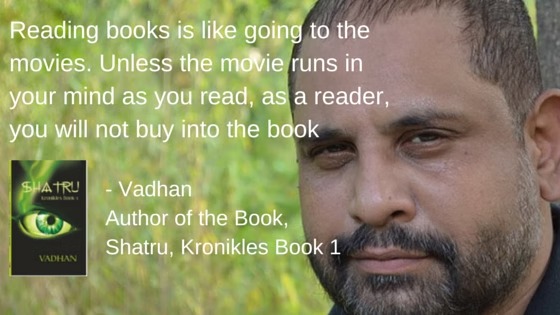
Ultimately, it was my decision on what to keep and what to throw away in my book. A 90,000 words book was reduced to three quarters its size once the four editors finished. That is how a book is written. That is why writing a book is not about writing a book. It is about choosing the best possible way of presenting your work to the world.

In my case, the results are all four out of five star reviews in every forum and by every reviewer. I am glad I went through the pain just so I can savor the pleasure.

So, the best editing award goes to…the author!

Heck, its my book!

My eternal thanks to my wonderful editors, those fantastic skin grafters and plastic surgeons, without whom my book would not have been what it is.

My tryst with horror comedy

This is not an ad for Dean Koontz!

Dean Koontz has sold 26 million books world wide.

He is one of the most unique writers I have had the good fortune of reading.

He is that writer who, in my opinion, has done a remarkable if not absolutely an impossible thing.

Let me not get ahead of myself.

To me the most memorable of his work is the Odd Thomas series. Life Expectancy and Tick Tock are also favorites. Seize the Night is another of his books that I love. I think its got a sequel.

All the books I’ve referred to here are examples of Koontz’s horror comedies. Odd Thomas is a regular guy working as a flash cook in a small town. Only thing is, he sees dead people and demons. He is popular around town and the cops love him because he helps them solve crimes. The first of the Odd series is an amazing book that keeps you laughing through out though there is an underlying feeling of dread. The twist in the end leaves a lump in your throat. The horror is very real and so is the comedy.

In Life Expectancy the Hero and Heroine meet each other only when they are taken hostage by an insane villain and his two equally loco buddies. They are robbing a bank more to take revenge on the town than to become rich. The villains plan to do away with the hero and the heroine. By the end of the chapter, the two have fallen in love and the heroine is categorical that she will not name their first born after the villain’s father. The clocks ticking against the couple all the time.

As a reader I was glued to the book.

Glued.

Period.

Now here’s the thing I wanted to say. Horror and comedy deal with two extreme emotions. I mean they are poles apart, two of ends of a rainbow, night and day, the ends of a paradigm, so on and so forth. You can laugh out in terror. It’s a mental reaction. Its your brain’s way of trying to numb the impact of fear, pain or horror. You can laugh because its funny. That is a release. A sense of happiness, glee, bliss even. Bringing them together is no mean feat. Keeping the action running, getting along with the story while keeping true to the plot and at the same time making people laugh is a gift that few in this world possess. Pathos and comedy are of the same ilk as horror and comedy. Classic example of the former is Charlie Chaplin and of the latter is Dean Koontz.

Horror Comedy is not a great favorite in India. There aren’t many writers who can attempt the genre. I don’t want to be one of them. The dream is to write in the comedy horror genre. One day. Some day. I will.

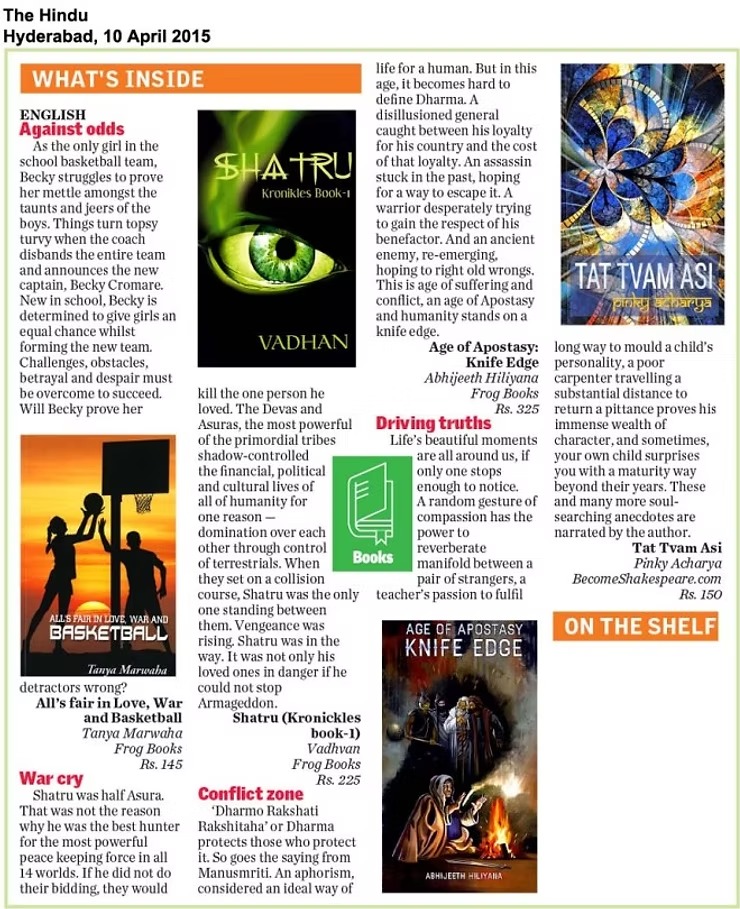
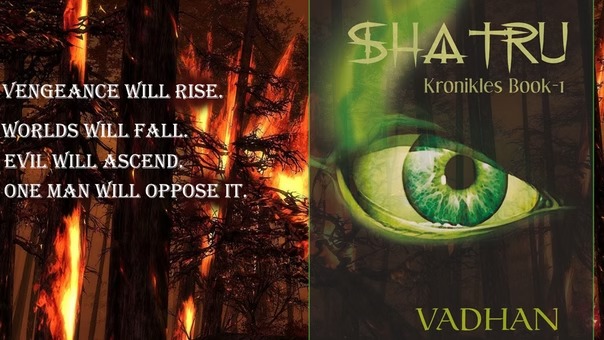
Shatru-Kronikles #1 Free Press Journal Mumbai,3 May 2015


Why Is Fantasy Fiction So Popular in India?

Well, because it is India. 1600 languages. Each language has a culture. Each culture has a treasure trove of stories to support their belief systems. We’ve waded through the waters of myth from the time we could understand the spoken word.

Mom used to take me out into the moonlit night. She used to hold a silver bowl full of sweetened milk rice. She pointed the moon to me and said that she would tell me how Lord Ganesh was cross with the moon one time and cursed it, if I eat the food.

My grandmothers, (maternal and paternal) brought me up on a heavy dose of Ramayan and Mahabharat. My paternal grandmother told me stories of my forefathers, their hunting days, the way they chased after bandits and thieves and how they took care of the subjects of their little fiefdoms.

As soon as I was good to read, I started off with Amar Chitra Katha comics, Jataka tales and Panchatantra came to life with monkeys, donkeys, birds and deers teaching me how to lead a moral life.

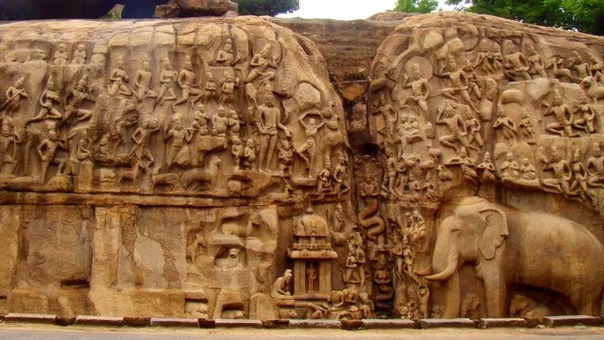
Every celebration we have in this country is linked to a mythical battle of good over evil. In the north of India, Diwali, the festival of lights, (and a whole lot of fireworks) constitutes the celebration for the return of Ram to Ayodhya. Down south, it constitutes celebrations for the slaying of Naraka Asura by Krishna. One festival, two different stories.

The Dussera festival in the East and South of India is to celebrate the slaying of Mahisa Asura by the Goddess Durga and her avatar, Kali. In the North it is the celebration of Ram’s victory over the Asura, Ravana.One festival, two stories. Each culture, each language has its own story.

In India for instance, Hanuman is considered a bachelor. In Thailand, he is considered a married man. In some belief systems, Lord Ganesh is considered a Bachelor. There are yet other belief systems in which he has two wives, Sridevi and Mudevi.

There are two stories as to why Lord Ganesh, the popular elephant headed God, has a broken tusk. One story is that he used the tusk to defeat the terrible Gajamukh Asura. The other story is that he used the tusk to write the Mahabharat as Sage Vyas dictated the great epic to him.

Stories abound. Authors have given their takes on the stories in fantasy novels in India. We grew up on fantasy. We are probably the largest market in fantasy. Everyone knows it,except publishers!

And then someone has to go and ask why fantasy fiction is so popular in India. Seriously?

Fantasy Is an Escape from the Rut of Life

In a world moving fast… (Sounds like a trailer, huh?) we are constantly on the run to at least try to meet with the pace of day-to-day life. We are so engrossed in our mundane routine that 24 hours is not enough to finish our daily chores. Tired, listless, bitter, these words don’t even begin to explain what we feel like. That’s when the word ‘enough’ actually sounds good.

A door closes, shutting out the ‘fast moving world’. Another one opens-bright, well oiled, easing us into a world we all love to be in.A world where we are the heroes, where we save the day, consistently. The trailer is over and life starts in the fantasy world. The pages flip. Timeless, countless, ensconcing us in mayhem and order, riches and valor. Seriously though, imagining an alternate world is normal for most of us. From when we are kids, we learn to build our own world, imagine things including fantastical adventures, great relationships, fantabulous careers and grand riches. Sometimes we even work to make it come true.

Psychologists believe that a little bit of “Fantasy” is a healthy and productive way to self-manage hardship, disappointment, depression, and lack of opportunity. Scientifically, a magnified sense of optimism helps most people cope with the daily drudgeand achieve more than they would if they had a realistic expectation of what the future holds.

Being in the shoes of a larger than life adventurer or fighting foes ten times more powerful and beating the living daylights out of them is fun. Yeah, it can’t be done in real life, so what? That’s why fantasy fiction is so damn popular. We want to live big, dream big, party hard and earn tons of money. Larger than life has a certain charm to it. Fantasy fiction allows a guy or a gal to live through that larger than life dream. Who knows, maybe it will help you become that hero everyone loves.

Subscribe to our newsletter

Email *

Vadhan

Author Of Best Selling Fantasy Books