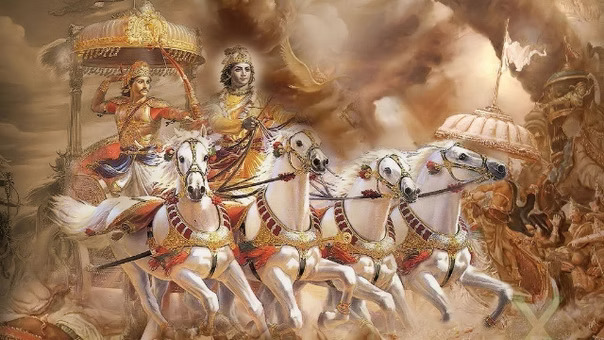
Krishna V/s Krishna’s army

I was brought up with anecdotal stories from the great epics of India. The Ramayana and the Mahabharata. While one epic dealt with the ideal man, Rama, the other dealt with a worldly man, Krishna. While Rama stood by a strict code of discipline that did not let anything, even the love for his dear ones, interfere with his professed duties, Krishna broke every rule in the book just to ensure the people he loved survived the great war of Kurukshetra.  Both are considered to be avatars of God.

Of course, if you ask me to choose, I will go with Mahabharata. Why? Well, one reason is, it’s far more complex. And riveting.

There is this one story that comes to mind from the Mahabharata. A little tale. Recent events in my life have managed to spring this story into my mind all of a sudden. The story showed me the path I should take. The closed road that diverted me down an un-trodden track offering a bouquet of opportunities. You see, that is the thing with the epics. They are timeless. Their wisdom is limitless. They apply today as much as they did on the day they were written.

The little anecdotal tale is of particular significance to me because it showed me how much or how little I am valued by those I threw my lot with. It so brilliantly aligned my thoughts and showed me the way forward. For that, I am indebted, as always, to the masters of Indian lore.

Well, here’s how the tale unfolds.

The background is important. There’s a great war about to be waged between cousins. On the one side, the hundred Kaurava brothers and their limitless armies. On the other side, the Five Pandava brothers, arguably the finest warriors of their time, and their armies. The fight itself is about who is the rightful heir to the throne of Hastinapura.  While the Kauravas claimed the throne as the heirs of the first born, the Pandavas claimed the throne as sons of the king who renounced the throne. Something like the Game of Thrones, I suppose.

A good lawyer could have argued successfully for both sides, I think.

Anyway,  as the opposing parties are out gathering allies to wage the great war, they land up in Dwaraka, Krishna’s kingdom, seeking his help. There are two versions to the story. I’ve opted for one of them.

Duryodhan, the first born of the Kaurava clan on one hand and Arjuna, the third born of the Pandavas on the other, arrived in Dwaraka. While there was no love lost between Duryodhan and Krishna, Arjuna was Krishna’s most favourite person in the world and vice-versa. Moreover, Arjuna was married to Krishna’s sister.

When Duryodhan and Arjuna came into Krishna’s chamber, he was napping. So, Duryodhan stood by the head of the bed as he thought, the positioning strategically befits a king. Arjuna stood by the leg end of it. Naturally, when Krishna woke, he saw Arjuna first and was delighted to see him. There’s a lesson right there. Krishna did not see Duryodhan who was standing slightly behind him. This angered the fragile ego of Duryodhan.

When the cousins had stated the purpose of their visit, namely, to solicit his support to their cause, Krishna had a proposition for both cousins. It was, since both of them were close to him, he would not deny either of them his support. The question was, what could he offer both of them?

Krishna therefore made an offer. One could opt for his army while he would personally support the other. Also, that he would not raise arms against both of them. Duryodhan being the elder of the two cousins, Krishna asked Duryodhan to choose first, which assuaged Duryodhan’s bruised ego.

Duryodhan thought. Krishna was one man. He would not fight. He was of no use.

Arjuna thought, Krishna was God incarnate. His counsel would be invaluable. More than any army they could raise.

Duryodhan chose Krishna’s army. It was a large army of highly skilled warriors dedicated to their Lord. Arjuna was delighted. He knew then and there that Pandavas could claim victory.

So it was that Krishna directed his army to fight with the Kauravas whereas he went with the Pandavas.There’s another lesson there. Could an army fight against its king, even at his own bidding? Therefore, should we make choices based on ego or common sense?

Moving forward, the great war was waged. It was fought bitterly. There were heavy casualties on both sides but the Kauravas lost the battle. Their larger armies were decimated. The hundred brothers were killed. Entire kingdoms and regal families were wiped out. All in the course of 18 savage days.

Now,  moving forward in time, I found myself at the short end of the stick because someone chose mine instead of me. Krishna’s army instead of Krishna. The real value, Krishna, was ignored. Even sidelined. I did not see a way out. Until the story popped up all of a sudden in my mind’s eye.

And my path became clear to me.

I have to pay kudos to the great Veda Vyas, the author of Mahabharat. He wrote the tale about something that happened 6500 years ago. And its relevance and message is so vivid to me that I am lost for words to praise the master.

#India #inspirationalwriting #Mythology #Teachers

The Real Me

There is no real me. Seriously, there isn’t. I thought there was. For instance, I am a…

lawyer by qualification and profession,

A writer by choice and passion,

A father,

A husband,

A brother,

A son.

A grandson.

I am sure I’ll be a grand dad one day.

And I am planning on doing a lot of other things.

But is that what I am? Is that what defines me? Or,  is that how I want to limit myself? I think not. I am much more. Because I am not just me. I am a consciousness. I am not locked into a body that would deteriorate enough to snuff me out. I am a consciousness which I believe also possesses a body.

I have written on it earlier, and I believe it to be true that I am the universe. I am part of the great beauty that is the universe. I am part of the great beyond that is the universe. It has made me only for one reason. For itself. To see itself through my eyes, and yours and everybody else’s. Through the eyes of the eagle and an ant. And somewhere in between, there I am. A minuscule part of the greater whole.

What happens to me doesn’t matter in the larger interests of the play. The play’s not being enacted for me. I am just part of the play. One of the actors. What happens to the play ultimately matters, not what happens to the actor. It is known as the Jagat-natakam. The play of the universe.

So is my identity that of a lawyer. It’s a role. A writer? I want it to be what defines me, but honestly, its another role. A father doesn’t define my role, nor that of a son or a husband. These are the layers, the coats of paint. But remove them all, I, the canvas, will still exist. The roles add colour to me, just like our atmosphere adds twinkles to a star. And there’s a great truth hidden in there.

Do I want to be liberated from my roles? Can I be liberated from my roles? Is that liberation at all? Is that what the universe wants? They might not define me, these roles, but they are not my shackles either. They are ways in which I express myself. These are ways in which I CHOOSE to express myself. When I say ‘myself’, it’s not Vadhan. He doesn’t exist outside the universe just like my hands don’t exist beyond or outside the rest of my body.  I mean therefore that this is how the universe wants to express itself.

Each of us, different from each other, is nothing more or less than a unique experience of the universe. Like tasting wine, or beer or whisky or all of them. It experiences each of us to learn and grow. I believe that. Sometimes, it doesn’t like what it learns, sometimes, it does. We contribute either way. That, ultimately, is our role. Our definition. We are here for the pleasure of the universe. It is the journey that matters. Not the destination. For instance, it is the struggle to become the world famous actor that matters and once you get to be that world famous actor, you realize the emptiness it offers. Many discovered that. The latest is that great comedian and actor, Robin Williams.

Why is the journey so important? Because each journey is unique. A LEARNING experience. And the universe, however old it is, is still young enough to want that experience. I said I don’t matter. That is true for more than one reason. I don’t matter as an individual but I am the universe as well. So, I don’t exist when I am alive, I exist even after I die. Because, in some form or the other, I the consciousness, will work for the greater whole. My journey, experiences and discoveries never end.

Is it reassuring? I didn’t mean it to be. To me, it is a fact. The journey ceases to be an experience if it is monotonous. There is nothing to learn once it gets boring. So the universe will reinvent itself, by reinventing me and letting me experience and learn for it. Just like we reinvent our lives, our marriages, even our driving experience. It is an everyday truth on a larger scale.

That is how I see myself. As a probe. As an antennae, an explorer. A chronicler for the greater part of me.

Ten things to do to be a bestseller!

The big question, isn’t it? What makes something what it is? What makes one book a success and another a failure. Other than the obvious facts of  a choice of cover, prudent marketing, shameless sales pitches, begging people for reviews, wringing your heart out to your stone-hearted publisher to get the books to the stands. If you do succeed in most of these things, the book will get out there. But, then what? What makes a reader pick up the book rather than the one next to it.

Given that India has tons of writers trying their luck at getting out the next bestseller, what is the one factor that will make your book a bestseller? What is that formula X that’ll get you movie rights (which hopefully you haven’t signed away to your publisher) get you invited to prestigious literature festivals and throw you into the limelight.

Could it be something as simple as an appealing blurb? The genre? Your image on the cover? The opening lines of page one? All of them? None of them? Sheer dumb luck?

To be honest, I am still trying to get my head around it. To me, it is not just one thing. It is the ability to do the right thing right. Sounds easy, I know. But, let me tell you after loads and loads of experimentation that it is one of the hardest things in the world to do to get both rights, right.

What do I mean? To-do-the-right-thing-right. Two rights. Right thing. Do it right. If you do the right thing but in a wrong way, it gets wasted. If you do the wrong thing, there is no point in doing it right, is there? So you must get both rights, right. Right?

For instance, I had a moderate marketing budget. I spent too much of it doing all the things that my digital marketing guy said was important. I should have known when he said ‘results are not assured’ that he was making money. So, after a lot of snazzy digital images, online quizzes and what not, I found that it had no impact on my book sales. It brought in a lot of interest but for all the wrong reasons. I should have focused on driving people to the market place. They were just gawking at the pictures. Not the same thing.

So, without going into obvious things like writing style and ‘showing the audience rather than telling them’, the important thing I find is centrifugal to making your book a success are:

  1. Awareness creation that you as an author exist.

  2. Book trailers are a great draw. But, be professional about it.

  3. Reviews, reviews, reviews.

  4. Exposure in the right mediums. Literary mags, newspapers, literary platforms, online and offline.

  5. Reviews by those that count.

  6. Talking to people about your book. Wherever, whenever.

  7. Giving away your books for free to as many people as you possibly can. (A famous author once said he gives as many as 2000 copies of his book away each time.)

  8. Reviews by those who count. (Yeah, I am repeating it for a reason.)

  9. Remember, the author sells, not the story. (you buy your favourite authors, right?)

  10. Create your loyal followers.

Vadhan

Write to me at authorvadhan@gmail.com if you have anything to say to me…I love to read your opinion.

Publishing Non-Fiction, Risk of Libel

Reputation is an idle and most false imposition; oft got without merit, and lost without deserving.

William Shakespeare

Nothing could describe reputation better than the quote by Shakespeare. It is a flimsy thing and substantial at the same time. And nothing could be more damaging to a person than what another has written to defame this fragile shadow of character. But that is not the start all and end all of defamation. There is a flip side. Truth can be hard. Truly hard. And when written starkly to describe the activities of another, defamation of reputation is used as a sword rather than as a shield to strike down the right to free speech.

Thus, we come back to the wisdom of Shakespeare’s words–‘Oft, got without merit and lost without deserving’. They are potent sentences, stark and shining with the light of his wisdom. When reputation is acquired without merit, losing it is bitter. When reputation is gathered through years of stable character, losing it is undeserving.

Thus, the law steps in to protect people from those who cry foul to defeat freedom of speech and those who lose their well-deserved reputation through libel and slander.

I am concerned, in this article, with libel. My exposure over the last few years has been to establish that non-fiction manuscripts don’t have an impact on the three entities responsible for them, the author, the publisher and the printer.

In India, unlike in any other country in the world, defamation is, in addition to being a civil tortuous liability, also a criminal offense. Most non-fiction I deal with is politically charged or is by the intelligence community intending to write their bit on the ongoing turmoil in the country on religious, political and anarchist grounds. Many truths are revealed, many half-truths unearthed, and many opinions voiced out.

My job is to protect the publisher, by far the most susceptible to an action by vested interests antagonistic with the publication of such material. They offer the softest target to such vested interests who either want publicity, wealth or validation of their image by a doting public. Going through a manuscript, most times unedited, to review every single statement in order to validate its veracity and weed out the unsubstantiated opinions and accusations from cold, hard facts is the only way to protect publishers from accidentally ending up shelling out tons of money and suffer the concomitant ill-effects of prolonged legal action. It is a critical task in the publishing process.

Sec. 499 of the Indian Penal Code sets out clear parameters of libel and what falls as exceptions to it.

In a nutshell, the applicable exceptions are:

1.     Imputation of truth which public good requires to be made or published.

2.     Public conduct of public servants

3.     Conduct of any person touching any public question.

4.     Publication of reports of proceedings of court.

5.     Merits of cases decided in court or conduct of witnesses and others concerned.

6.     Merits of public performance

7.     Censure passed in good faith by a person having lawful authority over another

8.     Accusation preferred in good faith to authorised person.

In addition is the advent of social media and online books and the principle of single publication rule v/s multiple publication rule which gains relevance from the point of view of the statute of limitation for invoking action against libel.

Publication is the critical aspect of libel. Unless something is published and reaches the public eye, it cannot be said to be libel. The law of limitation prescribes a one-year limitation for initiating legal action from the date of publication of such libel. When it comes to social media, the courts across the world considered the multiple publication rule which states that each time something was published or regenerated online, it created fresh cause of action leading to a never-ending cycle of cause of action irrespective of when the publication was made. Limitation period became irrelevant.

In recent times, the view changed in the United States of America and in the United Kingdom to the single publication rule which holds that a statement is considered as published as soon as it enters the stream of commerce, thereby effectively negating the multiple publication rule. In a far-reaching judgment, the Hon’ble Delhi High Court, in the 2013 case of Kawar Butt v/s Asif Nazir Mir, applied the single publication rule for libel on social media and internet publications thereby setting the stage for protection against frivolous action in India.

Publishers are worst hit by cases of libel. This is true in India as well. There are publishers who’ve faced more than a hundred cases of libel and those who have settled such cases by paying a fortune as compensation.

It is important to verify the risk involved in an action against them and to understand the defenses publishers have against such attacks through a valid review of manuscripts.

Freedom of Speech is not only inherent, it also needs to be protected or it will be throttled underfoot and left to succumb under the angry march of nepotism. It is important for publishers to know their rights, understand their obligations and protect themselves and their authors.

The author is a lawyer and published author. To get in touch with the author, write to authorvadhan@gmail.com

A Literary Lawyer for Authors

I love writing. It is the THE love of my life. I am an author of fiction. A published one. I signed up with two different publishers for my two books. The second publisher is one of the most famous publishers in the world. I even have a literary agent who is himself an author.

I am amazed at the number of writers in India today. People have stepped out of their traditional roles into a bold new world to express themselves. Most authors just want to get published. Traditional publishers are not easy to convince. They are tough to break and have set standards that are tough to match up to.

A literary agent can take a publisher through your work, convince the publisher to publish your book but can he or she  negotiate terms like royalties, advances and percentages? Publishers in India don’t negotiate with literary agents. Most publishers have their own contract templates. Normally, they don’t change the contract terms unless you’re a famous author. Even then, the going is tough. That’s when you need a lawyer to represent you. A lawyer who not only understands IPR law that protects you, contract law that would govern your relationship with your publisher but also is able to negotiate the best deal you deserve as an author.

I am not saying my responsibility as your lawyer includes vetting your work or revising it. Sure, I do that, but only if your story interests me. As your literary lawyer, I will look out for your interests when you step into the intricate and complex world of publishing, whether you’re going to talk to an independent publisher who helps you get self-published or a traditional publisher who’s willing to publish you.

  1. As an author you need to know what percentage of royalty you’re entitled to.

  2. Is it a perpetual contract or is it time bound?

  3. What are the rights and obligations of the author and publisher under the contract?

  4. What accounts and when a publisher should furnish those accounts of your book sales?

  5. What percentage of rights is yours in the event you sell movie or television rights?

  6. What happens when you don’t get your royalty even after its fallen due?

  7. What happens if you need to sign screenwriting agreements for your books?

  8. How you need to structure your marketing agreements with book marketers?

  9. When and in what circumstances are you entitled to terminate the publishing contract?

I believe in cost effective legal help. I understand the budget constraints of an author. I do. I am one. I am also a successful corporate lawyer for 26 years. I represent publishers and clearly understand their pain points.

If you want to get in touch with me, write to me at authorvadhan@gmail.com or call me on +91-95605-01785. At the least, I can advice you on what you need to expect, to start with.

I’d love to help you be happy with your book publishing.

listless

Listless,

Waiting for things to come,

invoking happy thoughts, know not where from

To mute the constant hum

of being listless

Aimless,

Adrift in strange waters sans a rudder

What’s to come, I consider, I shudder

Am I accustomed to lose or just getting better

at being listless

Sightless,

In bleak fog and a darker night

No measure of start or end without light

Why is there  no more fright

of being listless

Formless,

I float on an invisible sea

Having the prevision that I will be free

Of sightless travel and this aimless spree

of being listless

Hope,

When turning a corner I will see

the train with the prize heading towards me

when I will rise unlike a languid breeze

But like a raging storm that washes away how it feels,

to be listless!

#fictionwriters #speculativefiction #Magic #Life #inspirationalwriting

The One Minute Story

Eshwar was enjoying the rainbow. One of his favourites, the play of colours and elements that created a bow. A natural mood booster. Sometimes he needed mood boosters. Today, he needed a lot of them. It was one of those days. He had been in a conversation in the morning with his name sake. Only the initials were different. He was P. Eshwar. The other was S. Eshwar.

Their roles in the scheme of things were different. He was the provider. The balancer. S. Eshwar was…yes, a troubleshooter. You could call him that. Literally a trouble shooter. He shot people full of troubles wherever he went. He was a walking disaster zone. Yet, he had a place in the scheme of things. He had a role to play.

S was the stone heaver. He heaved stones at windows, people went about looking for that someone who can fix their windows. They invariably turned to P. He was always around. Business flourished. But it had its bleak moments. Like when both Eshwars had to speak about their respective roles. These days it was happening more often that P would prefer.

“If someone caught me at it even once, I am done for,” said S. Eshwar.

“You haven’t been caught yet.”

“They even pray that I don’t hit them.”

“So would I, if I were them.”

“Do you know how much of cussing and cursing goes on when they know it’s me? Why should I go through with it? Why can’t we exchange places? You have a great job, the great benefactor, the man of the hour. And me, the pestilence, the pain in the ass, the man everyone loves to hate.”

“Well, that’s your lot in life, S. It was the luck of the draw. You always knew everyone’ll hate you.”

“But…I hate to do it to them. Why should I?”

“What, are you growing a conscience all of  sudden?”

“You bastard.”

“Language, you know how I am about language.”

“Screw you. The other day, the fat merchant I hit lost everything. Apparently he had under-insured. He’s on the streets. Where were you?”

“Your job is to hit them. What happens thereafter is not your concern,” P said.

“It is my concern. I hit them so they turn to you. If you don’t pick up the strings from where I leave them, the whole thing is redundant. Got it? I am done with your games. I quit.”

P became agitated. S couldn’t just quit and leave. The man was trouble from head to toe. Literally.

“Listen, the merchant will get back whatever he lost. It’s just that the price is a little steep for him.”

S shook his head.

“He bore everything well. He did not waver. He did not lose faith in you. If you let him down…I can never forgive myself. My work’s already tough. People pray that I don’t go to them. I am more hated that Y. And everyone hates Y.”

“Yeah, but then, if Y hits, people don’t get up again. IF you hit, they wish they did not get up again. Which is worse?”

“You bastard.”

“Language!”

S gulped, but stood his ground.

They sat in silence. Presently Shaneshwar simply walked away. He did not look back. It was defiance. But it was no good. It was his job. He had no choice. Parameshwar felt for his old friend but there was nothing really he could do. Rules were rules. He thought about it and the rainbow came up. He smiled again.

He felt the presence before Y made it to the bench to take S’s place.

“Yes, Yama Raja, how are you?” said Parameshwar.

It was going to be a long day…

Cast:

Parameshwar-God

Shaneswar- Demi-God of  bad luck

Yama Raja- Demi-God of death

Are We Independent or Are We Just Free?

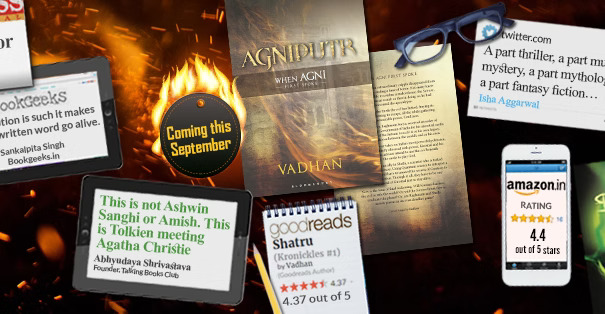
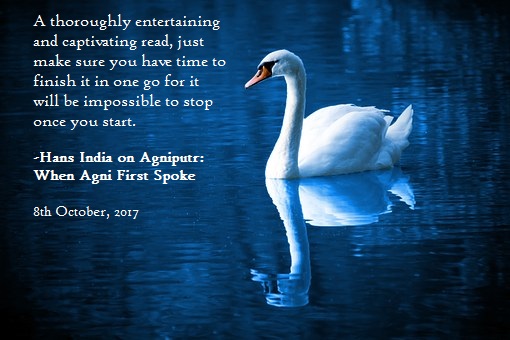
On the 71st Independence day for India, I am chipping in with this very relevant excerpt from Agniputr: When Agni First Spoke, my book. The debate between a senior Union Minister and our heroine, a Scientist, is, are we independent or are we just free?

I hope you enjoy it

“But didn’t we suffer at the hands of the princes and kings? Didn’t they tread on the people for their own riches?” she asked him.

“Yes, of course they did. But there is a much more important question you need to ask. What are we doing now? Are farmers not committing suicide now like they used to under the kings and zamindars? How much out of the government declared welfare schemes are actually reaching the target audience? Is there even accountability of where it goes? How different is an elected representative from a king or a zamindar in India, today? What are we doing about it? Aren’t we unearthing scams day after day, every month of the year? Is that not worse than it was? Ask yourself Sheilaji, have we really attained independence or is it just freedom from foreign rule we are gloating about?”

“What’s the difference?”

Choturam smiled sadly, as though it was painful to learn that he had to explain such a fundamental difference to a highly educated person.

“When an adolescent moves out of his parents’ house to go to college, he considers it freedom. He gets pocket money, does not have to give accounts for it, does what he pleases, and experiments with all the goodies his age and life have to offer. That is freedom, unbridled, uncontrolled, without a care for anyone and anything. Independence brings responsibility with it, not only for yourself but for the other independent people around you. It sets a value system which rests on respecting your neighbour’s independence and expecting him to respect yours. It comes with the ability to understand the rules of peaceful co-habitation. One look at the traffic management system in Delhi and you know a majority do not respect traffic laws, be it one-way roads, speed limits, lane rules, the list goes on. It is a singular indicator of how we treat our independence. Are we respecting and therefore acting as responsible people who value their collective independence? Or are we simply saying we don’t care about the others as long as we get to do what we like? We are dependent on a corrupt non-functional system that allows us to do what we want, just like the adolescent who gets his pocket money that he does not have to account for. And if that is the case, then Surya was right, we are too immature to be a democracy because we really are incapable of making a choice. Instead we choose those who promise to give us the most pocket money.”

To live. To breathe. To actually dare…

This means a lot to me. A review. It ratifies everything I dreamed about for my book. My book is a dream. My dream. And here is someone who believes in it enough to live in it and lives it so much because he loves it and loves it so much that he takes the time out, his valuable, precious time, to write about it. I am obliged. I am indebted. I am humbled.

Truly, what else can I as an author, as a dream merchant, as this lone guy typing away into the night, ask for? Nothing really. When someone says they read my book in five hours flat through two airplane rides, or when they say they don’t want to write about the book but about the author, I begin to live. I begin to breathe. I actually dare to smile, to laugh, to cry…

Thank you!

Subscribe to our newsletter

Email *

Vadhan

Author Of Best Selling Fantasy Books